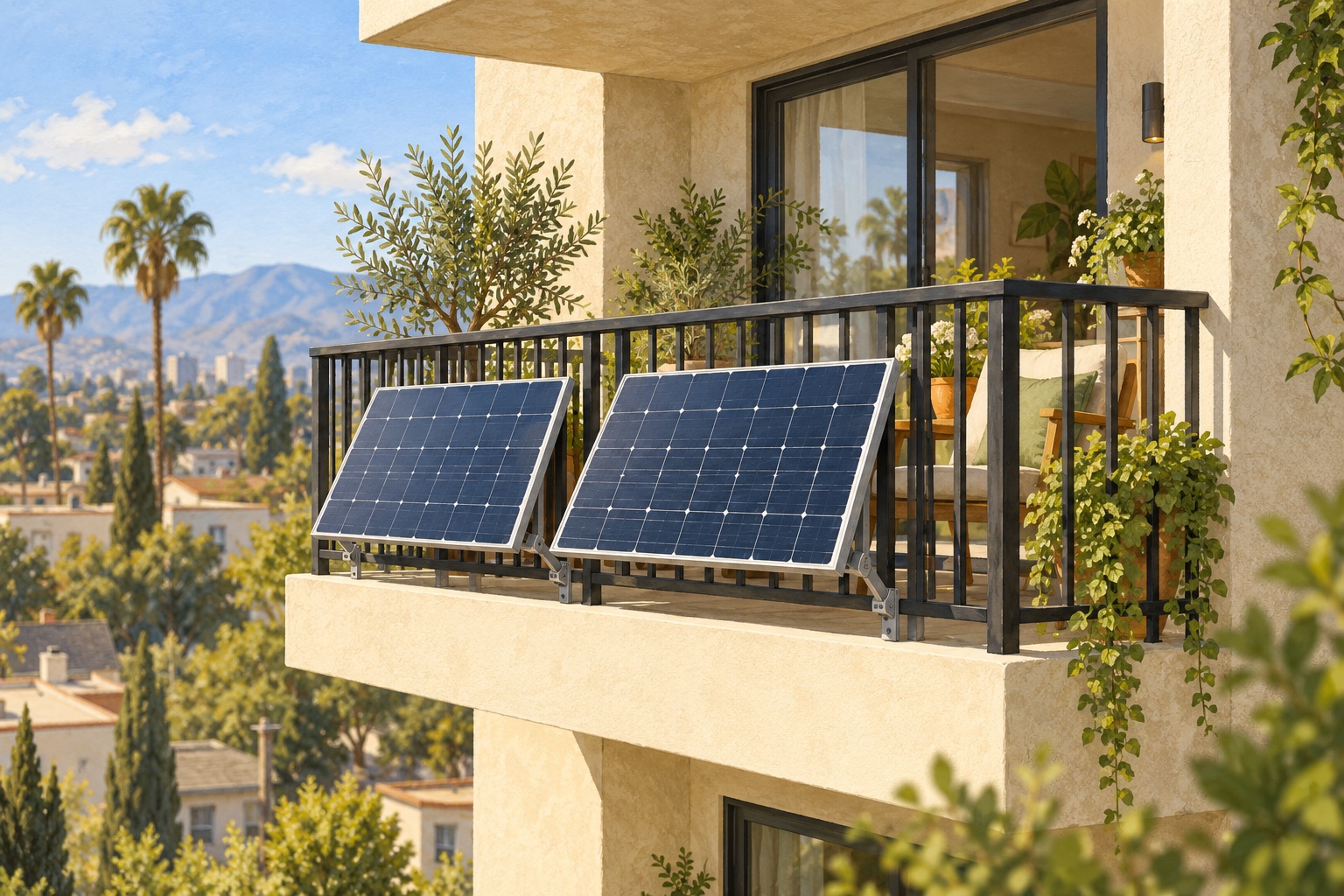
California’s new framework takes effect January 1, 2027.
Use it when it is made
Match solar production with daytime use to make more of your own energy.
A battery is a separate decision
Compare storage costs and extra usable energy with the calculator below.
AI editorial illustration · Generic equipment, not a tested product or documented installation.
You do not need a big roof to be curious about making your own clean energy. Plug-in solar opens an intriguing possibility for smaller homes and sunny balconies: use a little local sunshine to power part of an ordinary day. California’s new framework begins January 1, 2027. Here is how to explore that opportunity, with the rules, equipment, and savings in view.
What California changed
California’s SB 868 gives small-scale solar a new opening. Signed September 30, 2026, it exempts qualifying plug-in devices from utility interconnection requirements beginning January 1, 2027. A utility may request simple online notification rather than prior approval. The exemption runs through January 1, 2030 unless the law changes. That is a meaningful opportunity to explore, not permission to connect any kit today. Sources: California SB 868: enacted text · CalMatters Digital Democracy · Bright Saver state tracker (advocacy organization and seller)
The framework is built around limited-output, safely isolated systems: combined AC output of no more than 1,200 W per dwelling, electrical-code compliance, certification as a plug-in photovoltaic system by UL or an equivalent recognized laboratory, and certified isolation during an outage. Those conditions define the opportunity. They do not establish payments for exported energy or make every online kit eligible. Sources: California SB 868: enacted text
Before connecting a system
Use the preparation period to find a well-documented kit and a secure place to mount it. Confirm its exact listing, approved configuration, circuit suitability, and local requirements, along with landlord or association rules. Follow the certified instructions and involve a licensed electrician when electrical work is needed. A shipping offer is not a legal or installation approval.
A complete-system listing makes the purchasing evidence much more useful. UL Solutions describes a dedicated plug-in certification program based on UL 3700. Check that the listing covers the actual combination you plan to use; component certification alone does not approve a whole assembly. Sources: UL Solutions: plug-in system certification
How a little solar reduces a bill
The simplest saving happens while sunshine and household demand overlap. A refrigerator or another daytime appliance can use solar energy that would otherwise come from the grid. Match generation to those familiar loads to make more of a small system. If generation exceeds demand, the surplus is not automatically a bill credit, and a zero-export setup may curtail it.
Think of output as a pattern across the day and year, rather than one number on a panel. An 800 W nameplate is not 800 W from morning to night. Balcony direction, shade, seasons, temperature, inverter limits, and losses change production. Peak-sun hours translate sunshine into equivalent full-strength hours, rather than counting all daylight.
Here is a small-system example you can make your own. With 800 W, 4.5 peak-sun hours/day, an 80% output factor, and 60% direct use, annual generation is about 1,051 kWh. At $0.35/kWh with no surplus credits, direct use saves about $221 a year, averaging $18 a month. A $1,000 all-in solar setup has a simple payback of about 4.5 years. These are editable assumptions, not a statewide forecast; your sunlight, loads, and costs are the useful inputs.
You can explore a second research perspective with HTW Berlin’s solar and storage tools. Comparing models is most useful when you understand their input data and timing assumptions. A calculator is a way to explore possibilities and ask better questions before buying. Sources: HTW Berlin: solar and storage research tools
YOUR NUMBERS / YOUR DECISION
Will balcony solar pay off for you?
Compare the first-year bill savings of solar alone and solar with storage. All amounts are US dollars. Estimates stay in your browser.
SOLAR ALONE
estimated annual bill savings
/ month, annual average
SOLAR + BATTERY
estimated annual bill savings
Battery adds / year / month, annual average
Solar simple payback
Added battery simple payback
Combined simple payback
Battery benefit over years, minus purchase cost: . Constant first-year savings; excludes degradation, financing, maintenance, and replacements. This is a sensitivity check, not a lifetime forecast.
Seasonal savings, at a glance
Green: solar alone. Charcoal: solar + battery. Negative savings appear in the table.
View monthly figures & energy breakdown
Monthly first-year estimates · US dollars and kWh
Month
Solar generated · kWh
Solar savings · $
With battery · $
Generated
Used directly
Delivered from storage
Battery cycling losses
How the calculator works and its limits
Daily generation = min(panel watts, inverter watts) ÷ 1,000 × peak-sun hours × monthly sunlight factor × output factor. The California example factors are illustrative, normalized so the 365-day weighted annual average equals your entered sun hours. A flat profile uses 1 throughout. This is a representative-day model, not a measured or hourly simulation.
Direct use is limited by your entered share of solar generation and household daytime demand (total demand minus the demand reserved for stored energy). Monthly household demand is annualized and distributed evenly across 365 days. Stored input is capped by available surplus, usable capacity adjusted for round-trip efficiency, and demand available for discharge. One cycle per day is assumed.
Solar savings = directly used kWh × daytime price + surplus kWh × verified export price. Battery benefit = delivered stored kWh × later price − foregone surplus credits − standby electricity cost. Standby is conservatively priced entirely at the daytime grid rate.
Simple payback = upfront cost ÷ first-year annual savings. No positive annual savings means no simple payback. Savings omit fixed charges, demand-charge changes, minimum bills, tax credits, utility-program effects, battery power limits, hourly load matching, temperature, aging, and financing. Different sun and tariff assumptions can reverse the result. A suitable hourly model and verified product data are needed before committing money.
The idea is developing beyond California. This review identifies nine other US states with enacted frameworks, alongside California. The table separates laws already in force from later effective dates. Certification, circuits, notification, and property conditions vary; “in force” describes timing, not universal approval for every kit.
Qualifying devices; do not treat enactment as present-day exemption.
Timing conflicts deserve attention: Maine’s licensing board identifies July 29, while one advocacy tracker lists July 15; this table follows the board. Maine’s enacted law supplies the tier conditions. New Hampshire’s final law says January 1, 2027 despite a conflicting docket entry. New Jersey and Virginia dates are cross-checked against the Bright Saver state tracker (advocacy organization and seller). Absence from this table does not establish a prohibition; other states may have utility-specific or conventional approval pathways. New York’s bill was still awaiting a signature in the reviewed tracker.
Outside the United States
The international examples show several ways countries are opening a place for small solar. This is a confirmed selection rather than a worldwide directory. Follow the local rules and equipment standards for the place you live, rather than assuming a foreign kit can be imported and connected in California.
International examples · checked October 5, 2026
Country
Status
Conditions & source
Germany
Permitted for compliant systems
Up to 800 W inverter output in the simplified framework. Registration and product requirements apply. Consumer guidance
Austria
Permitted with conditions
Mini-PV up to 800 W. Notify the grid operator at least two weeks before commissioning. E-Control rules
Belgium
Permitted since April 17, 2025
CE marking and Synergrid approval are required; registration requirements vary by region and system. Grid-sector requirements
France
Permitted through the applicable connection process
Compliant preassembled plug-and-play equipment has a pathway; Enedis declaration/CACSI requirements depend on the setup. Enedis connection guidance
Switzerland
Permitted within the established small-system framework
Storage can extend the usefulness of a sunny day into the evening. A compatible battery saves some surplus for when you are home or electricity costs more. Size it around the energy available to charge it and the later loads you want to serve. Include conversion losses, standby consumption, cost, and aging so the extra benefit is worth the extra equipment.
In the example above, a 2 kWh battery at 90% round-trip efficiency delivers about 378 kWh a year before real-world hourly power limits. At the same $0.35/kWh rate, after 5 W of modeled standby draw, it adds about $117 in annual savings. A $1,000 battery has a simple payback of about 8.5 years. This illustrates the decision rather than predicting a product’s result: shade, standby use, direct consumption, and battery life can change the outcome.
Potential benefits
Use solar later rather than losing surplus value.
Offset higher-priced evening electricity.
Possible device-level backup with equipment designed for it.
Costs & limitations
Higher upfront cost and conversion losses.
Standby consumption, aging, and compatibility limits.
No automatic household backup during an outage.
If resilience is a goal too, ask exactly what the battery can power during an outage. Grid-connected equipment must isolate safely; separate backup outlets and approved transfer arrangements are different capabilities. A battery in a balcony kit does not automatically authorize it to energize home wiring in a blackout. Our calculator keeps backup value separate from bill savings instead of inventing a dollar return.
The environmental opportunity is to use local solar energy in place of grid purchases. The avoided emissions depend on where and when it is generated, so we do not assign every system the same carbon saving. Panels and batteries also have manufacturing impacts. Choosing a useful size, extending its service life, and avoiding unnecessary storage help make the project a thoughtful use of resources.
Purchase options, with the unanswered questions visible
Commercial disclosure: The links below are ordinary, non-affiliate links. Good Green receives no commission from them. These are researched options and watchlist entries, not tested reviews or endorsements of California eligibility. We have not verified a complete kit as ready for installation under SB 868.
Bright Saver balcony kits
California watchlist
Published member pricing: $285.30 for 180 W or $414.17 for 360 W, plus a $29 annual membership; the page also shows a $499 nonmember starting option. Check taxes, checkout totals, and membership terms.
A small footprint and modest daytime demand are the appeal here. The basic package has limited output and no included battery, so compare it with the energy you can use while the sun shines. The seller reports sold-out or preorder status and says California shipping awaits whole-system certification. Availability and shipping dates need a fresh check.
Listed at $2,250 with panels, mounting, inverters, and a smart meter. The product page offers a purchase route.
This larger package may suit a household with more daytime demand and mounting space. Compare that opportunity with the higher upfront cost, additional equipment, and smart-meter installation requirements. We have not verified California system-level eligibility. State-specific documentation still matters even when a sales page says “all 50 states.”
The manufacturer states its EZ1 inverter is CSA-certified to UL 3700 standards.
A purpose-built US plug-in ecosystem is worth following as eligible options develop. Before purchase, verify the complete kit’s listing, included parts, total price, and California availability. The inverter’s certification claim alone does not cover every possible panel, cable, receptacle, or storage combination.
Integrated storage and load shifting could make this category useful where a locally eligible system is available. We have not confirmed US balcony-kit stock, the exact California certification, compatible battery, or complete installed price. Treat it as a future option to watch. Portable stations and European balcony kits are different products from an eligible US plug-in home-generation system.
A public US affiliate program exists, but Good Green has not activated tracked links for this edition. EcoFlow US affiliate program. Enrollment and accepted products require separate verification; their availability will never determine our review conclusions.
Before paying a deposit
Request the exact complete-system model, certification record, and permitted configuration.
Confirm current state rules, utility notification, landlord permission where needed, and installation costs.
Check battery usable capacity, low-load efficiency, idle draw, power limits, warranty, and return terms.
Compare the full delivered cost in the calculator. Buy for a useful outcome, not the largest wattage on a box.
ONE GOOD NEXT STEP
See what your sunshine could do.
Try the calculator with your electricity rate, a realistic solar yield, and a complete equipment price. Compare solar alone with storage, then check the rules where you live. Share the guide with a neighbor who has a sunny balcony or explore organizations helping more people access cleaner energy.
Evidence you can follow
This is desk research. No product was supplied or physically tested for the article. Product prices and availability were checked October 5, 2026 and may change.
We combine legal documents with independent accountability reporting, international consumer advice, university research, and testing organizations. Bright Saver sells systems and advocates for the laws it tracks; its commercial interest is disclosed. Manufacturer statements remain manufacturer statements.
State laws, network requirements, consumer guidance, and product pages are linked beside the claims they support.
We welcome evidence that corrects a claim or date. See our corrections and contact policy. Material changes should be dated on this page. This article and calculator explain options; they do not certify an installation or replace a property-specific electrical review.