
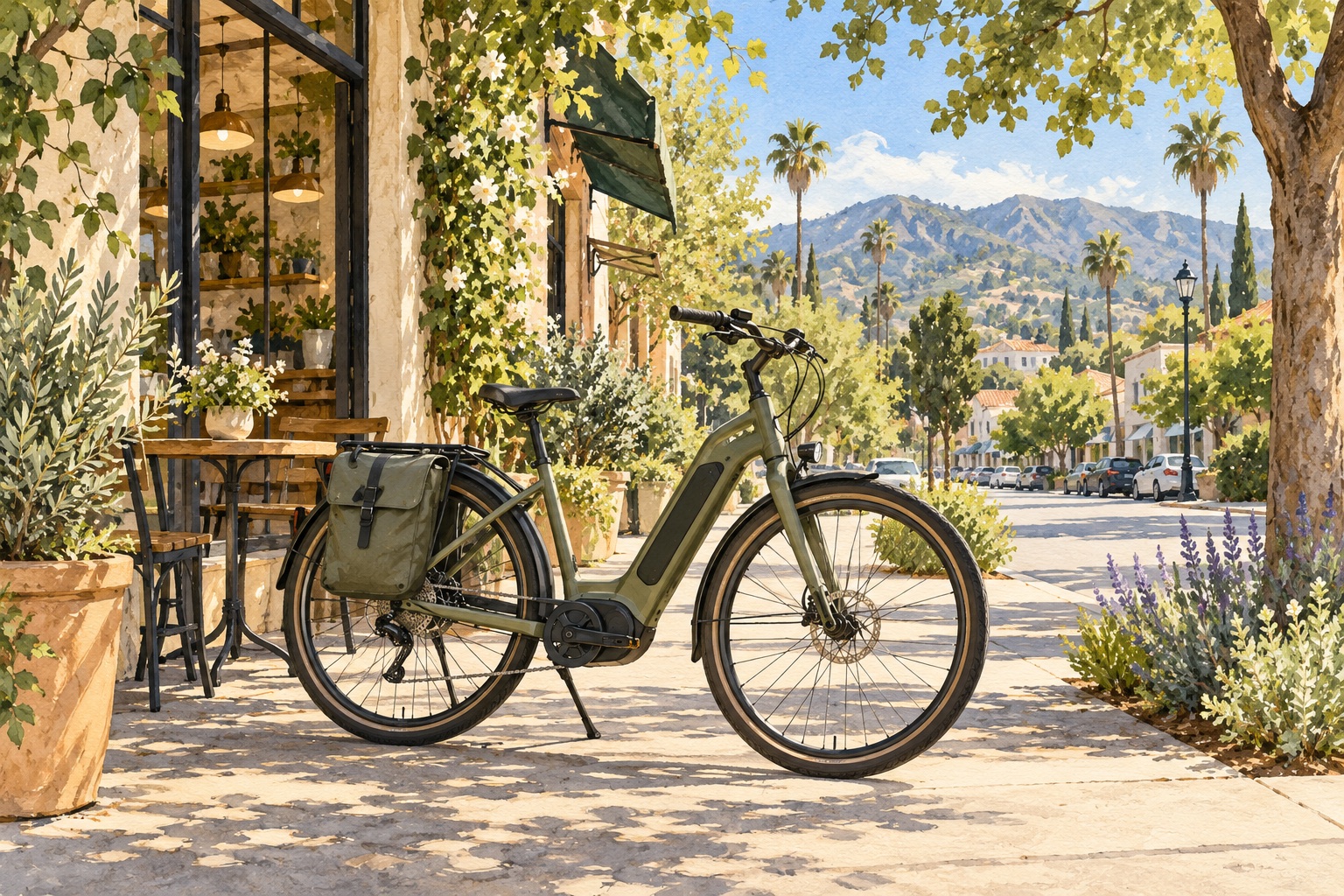
The grocery run can become a ride you look forward to. An e-bike’s assistance can make hills, a longer commute, or a loaded basket feel more manageable, opening up trips you might otherwise drive. The best fit is a bike that makes your ordinary week easier: comfortable on your route, practical to store, and supported by a shop that can keep it rolling.
Three options, three budgets
There is room for different budgets and different kinds of ride. The US price references below were checked October 5, 2026 and exclude tax and added equipment. Use them to explore the shortlist, then check stock and the exact configuration. Manufacturer range estimates are claims to compare with your route, not results from a Good Green road test.
| Option | Price reference | Why consider it | Tradeoffs |
|---|---|---|---|
| Aventon Level 3 | $1,899 list; $1,699 displayed sale reference. | A commuter with rack and fenders; manufacturer lists UL 2849/2271 information. | The manufacturer comparison page marks it discontinued. Confirm remaining dealer stock and service. Heavy for stairs; connected features have separate privacy and subscription terms. |
| Tern HSD P10 | $3,499 MSRP referenced in Tern’s 2026 cost comparison. | A compact cargo option with a dealer support model; useful for errands and suitable passenger equipment. | Seats, guards, racks and locks add cost. Check exact generation, payload, dealer stock and certification documents for the offered bike. |
| Lectric XP4 500W | $999 displayed asking price; $1,078 crossed-out comparison price on the selected offer, not necessarily a standalone bike MSRP. | A lower-cost folding option; manufacturer states UL 2849 certification. The 500 Wh configuration suits shorter town journeys. | About 69 lb including battery: folding does not make it light. Confirm local service and replacement parts; an advertised “up to” range is not a route guarantee. |
The price references come from Aventon’s US comparison page, Tern’s published cost example, and Lectric’s selected XP4 offer. These manufacturer sources help identify the equipment and asking prices; they have commercial interests. Confirm the checkout total and configuration, then check rider fit, local route access, and any passenger equipment you need. Sources: Aventon’s US comparison page · Tern’s published cost example · Lectric’s selected XP4 offer
Find your everyday favorite
Make the test ride feel like a real errand. Bring your usual bag, try a hill start and low-speed braking, and see how the bike fits your storage space. Remove the battery if you plan to charge it separately. Find a shop that can service its electrical system and supply tires, pads, chargers, and replacement batteries. A bike you can maintain is one you can keep enjoying.
A good everyday ride also has a secure place to park and a route you are allowed to use. Check the bike’s legal class, local access rules, and the manufacturer’s passenger instructions. Use a proper lock even if electronic security is included. For a short, flat journey, a conventional bike may already do the job beautifully; a used e-bike with verified battery condition and parts support can be another affordable path.
What could it save?
The energy needed for a useful ride can be surprisingly modest. In an illustrative example, a 500 Wh charge is 0.5 kWh, costing 17.5 cents at $0.35/kWh before charging losses. If it provides 25 miles, that is about 0.7 cents per mile. A 30-mpg car using $4.50/gallon gasoline costs 15 cents per mile in fuel. These are stated assumptions, not a measured range test, but they show why a replaced car trip is worth exploring.
Over 2,000 replaced driving miles, that example avoids about $300 of gasoline while using about $14 in charging energy before losses. Work out the net benefit with tires, maintenance, locks, equipment, insurance, and financing included. You keep an existing car’s insurance bill unless your circumstances let you avoid or sell the vehicle. Even without that bigger change, a bike can make a regular errand less dependent on gasoline.
Start with a journey that feels enjoyable and achievable. A comfortable bike, a useful route, and somewhere to store it are the foundations of a habit. Once the grocery trip or commute works, you can decide whether another journey fits too. Greener transport can grow from rides you want to repeat.