
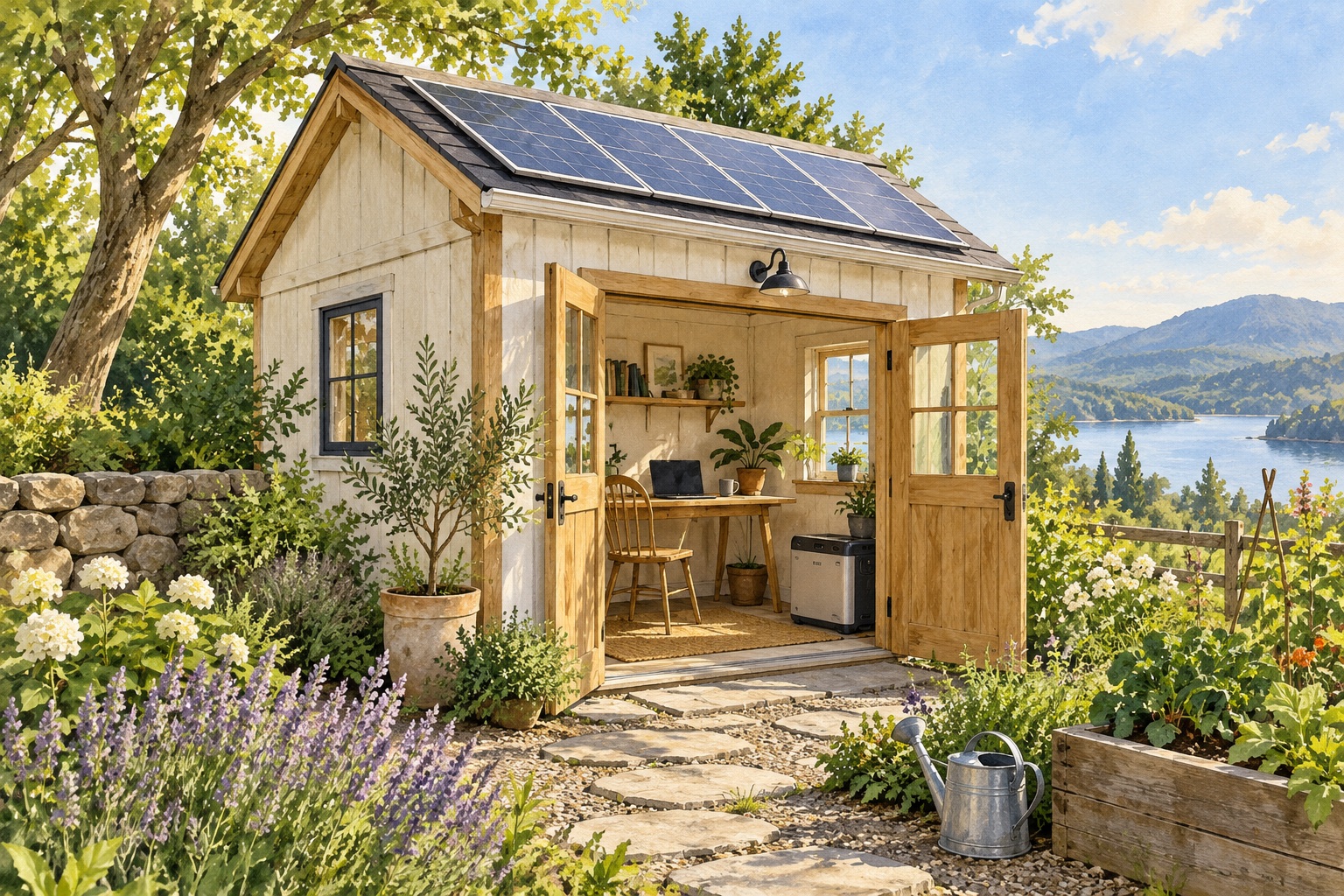
A sunny shed can become a small workspace powered by the energy falling on its roof. For lights, a laptop, and modest tools, solar and storage offer an inviting way to explore cleaner energy close to home. Begin with the day you want to power: a few hours of work, a charged tool battery, and enough light to finish a project. A heater, compressor, or large saw needs a larger design.
A small-office example
| Load | Assumed power | Daily use | Energy |
|---|---|---|---|
| Laptop | 60 W | 6 hours | 360 Wh |
| LED lighting | 20 W | 4 hours | 80 Wh |
| Connectivity equipment | 15 W | 8 hours | 120 Wh |
| Total | 560 Wh/day |
The small-office example gives you a starting energy budget. Measure your own equipment at the outlet, including standby use and tool charging. With an assumed 85% delivery efficiency, the example’s 560 Wh load needs about 659 Wh from the battery. Two days without charging require about 1.32 kWh of accessible storage; keeping a 20% reserve brings nominal sizing to about 1.65 kWh before temperature and aging margins. These are illustrative loads and assumptions, not guaranteed readings.
Keep the workspace useful through the seasons
Plan for the months when you want to use the shed. With four assumed peak-sun-hours and 75% overall yield, 400 W of panels generate 1.2 kWh/day. At two peak-sun-hours, that falls to 0.6 kWh/day, barely enough for the example before catching up after a cloudy day. Shade, panel angle, and weather can reduce it further. The seasonal comparison helps you choose enough generation for a workspace you can enjoy regularly.
Illustrative daily shed energy
Decide what a cloudy week looks like in your plan. You might accept fewer working hours or occasional charging from another safe source. Make that choice before buying, so the design serves the season and work pattern you actually want.
Choose a setup that fits your workspace
A portable power station can make a small project approachable when the loads plug into it separately. For scale, EcoFlow’s DELTA 3 Plus US manual lists 1,024 Wh of capacity and 1,800 W rated AC output. One unit does not meet our two-day storage example. Capacity sets the energy budget; inverter power sets what loads it can supply at a time. The manual is a specification reference, not a Good Green test result. Sources: Manufacturer’s US manual
Bring panels, station, and appliances into the same compatibility check. Compare solar input voltage, current, connectors, charge limits, temperature protection, idle consumption, and replacement options. An appliance still needs its specified voltage and continuous power; a marketing boost mode does not replace those requirements. We use this station to explain sizing, rather than award it a tested best-product rating.
For fixed circuits, bring in a qualified designer and treat the shed as a building installation. Wiring, disconnects, grounding, structure, weather protection, and permits may all matter. Keep batteries within their specified operating environment. Never feed building wiring through a makeshift outlet connection; a portable station is not automatically a weatherproof fixed system.
Compare the complete project with the cost of a permitted utility circuit. Off-grid solar offers flexibility and a chance to use local sunlight, especially where a new supply is inconvenient. If reliable grid service is close by, that alternative may be cheaper or have a lower overall impact. The rewarding project is the one that powers your work well with a sensible use of equipment.