
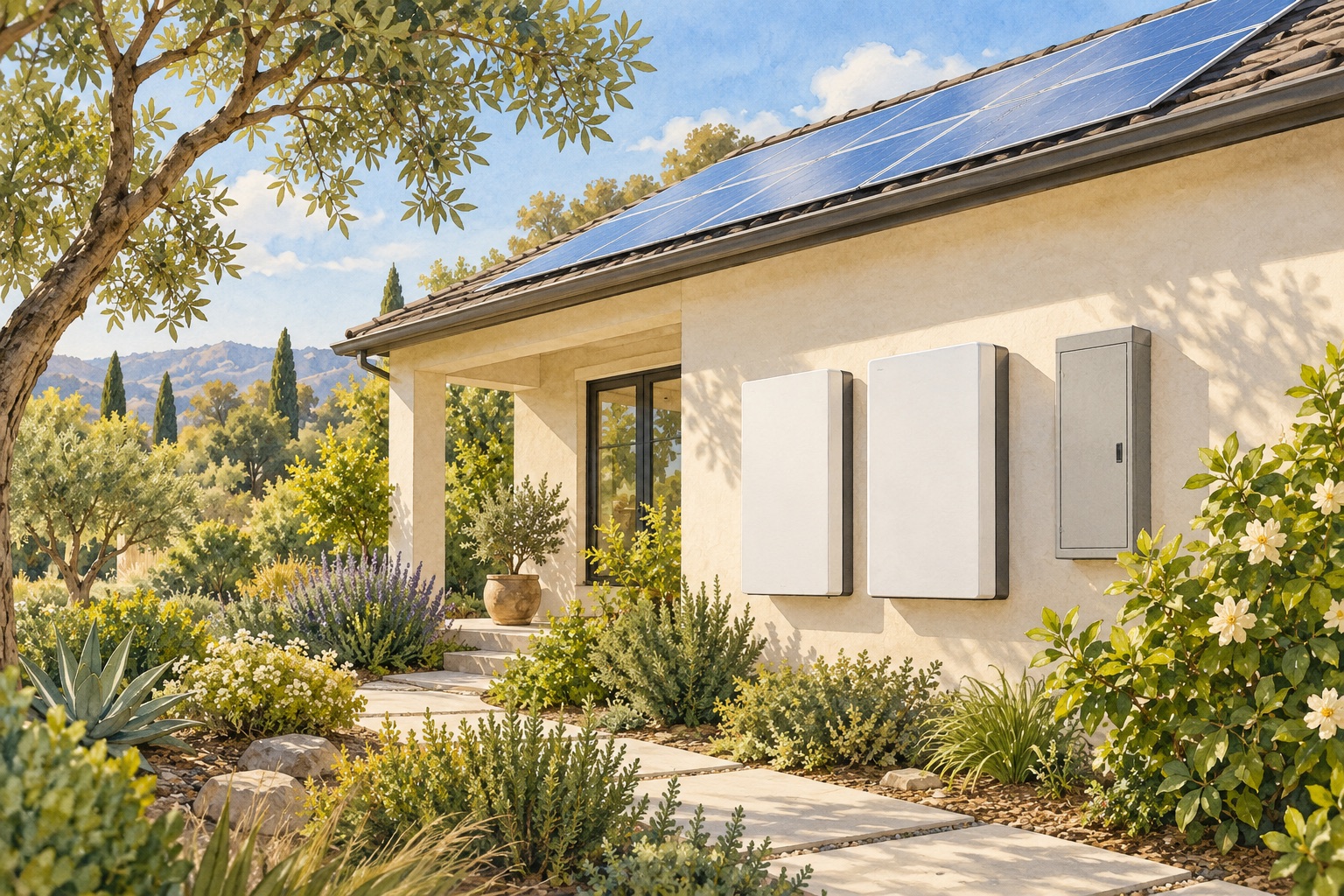
Keeping the refrigerator cold, the lights on, and your household connected through an outage is a practical kind of peace of mind. A home battery can also save solar energy for the evening or shift electricity purchases away from expensive hours. The opportunity is to buy enough storage for the job you value, at a cost that makes sense for your home.
Value first: compare the complete job
Affordable clean-energy equipment deserves a broad search. We compare lower-cost modular batteries as well as integrated systems, including international manufacturers, so a familiar brand is not the only route onto the shortlist. Our comparison is still growing, and it is based on published evidence rather than hands-on testing. We judge options by total cost, documented safety, compatibility, warranty, and local service. Our product coverage policy explains the publisher’s exclusions; commissions do not determine inclusion. Sources: product coverage policy
Use the October 5, 2026 price snapshot below to begin an affordable-system conversation with an installer. The two USD asking prices cover equipment only: tax, shipping, installation, inverter, and backup controls are extra. RUiXU’s reference comes from its US storefront; EG4’s comes from Current Connected. Ask for a written complete-system quote and usable capacity. Nominal dollars per kWh can identify options to investigate, but installed dollars per usable kWh makes the comparison useful. Sources: US storefront · Current Connected
| Battery / system family | Capacity & price evidence | Certification evidence | Value & tradeoff |
|---|---|---|---|
| EG4 WallMount 280Ah All Weather | 14.3 kWh nominal; quote required. | Manufacturer certificates cover specified 18kPV / 12kPV pairings to UL 9540. | Large modular capacity; compare the complete inverter, controls and installation package. A different inverter pairing is not automatically covered. |
| EG4 WallMount 314Ah All Weather | 16 kWh advertised; $3,749.99 battery-only (~$234/nominal kWh). | US retailer listing states UL 1973 and UL 9540; obtain the exact certificate and permitted inverter combination. | More capacity per cabinet; budget for inverter, transfer equipment and commissioning. Do not transfer certification from the 280Ah model. |
| RUiXU Lithi2-16 | 16 kWh nominal; $3,059 sale price battery-only (~$191/nominal kWh). | Manufacturer product page advertises UL 1973, UL 9540A testing and UL 9540. Request the listing document and system scope. | Low advertised module cost; full-system cost and local installer support remain unpriced. Manufacturer sales claims are not independent performance tests. |
| Pytes V5° | 5.12 kWh nominal per module; quote required. | Manufacturer UL 9540 system sheet specifies Sol-Ark pairings. | Modular sizing can match a smaller budget; cabinets, inverter and multiple modules add cost. Confirm model suffixes and approved configuration. |
| BYD Battery-Box Premium HVM-US | US configuration and installed price: quote required. | Manufacturer download center provides HVM-US UL 9540 and UL 1973 documents. | An international manufacturer with region-specific products. Do not substitute an overseas HVM/HVS model for HVM-US or assume its warranty travels with an import. |
| Briggs & Stratton SimpliPHI 6.6 | 6.6 kWh module family; quote required. | Manufacturer certification update identifies the 6.6 system as UL 9540 certified. | Expandable capacity; obtain the current certificate and supported inverter design. Older product pages still show certification “in progress,” so use current documents. |
| Canadian Solar EP Cube | Modular integrated system; quote required for the exact generation. | North American manufacturer catalog lists UL 9540 and UL 1973 for the cataloged models. | Compare integrated equipment cost against modular alternatives. A newer generation needs its own listing and quote; European specifications are not interchangeable. |
| HomeGrid Stack’d | Expandable stack; quote required. | Manufacturer specifications and its certification announcement warrant a model-specific certificate request before purchase. | A modular alternative worth quoting; minimum stack size, inverter and accessories affect affordability. Listing scope has not been independently verified by Good Green. |
| Enphase IQ Battery 5P | 5 kWh usable per US unit; quote required. | Manufacturer specification source; request the complete system’s current listing. | A benchmark for compatible installations, not our default value pick. Several units and controllers can raise the project cost; ask about newer models. |
| FranklinWH aPower 2 | 15 kWh usable; quote required. | Manufacturer specification source; request the current system listing and aGate configuration. | An AC-coupled benchmark. Compare installed cost with modular alternatives; brand recognition does not establish financial value. |
Where lower-cost rack batteries fit
Low-cost rack batteries make the affordability question interesting, but complete-system documentation is the bridge from a bargain listing to a home installation. ECO-WORTHY’s Cubix100 is one lead to investigate; listings differ by country and revision. We have not resolved its complete-system eligibility here, so it remains a research lead rather than an installation recommendation. A UL 1973 battery listing or UL 9540A test alone does not establish that any chosen inverter-and-battery combination is a listed home system. Request the certificate, exact model numbers, allowed configuration, and local acceptance. Its German listing also shows why overseas documentation needs a separate check. Sources: German product page
Build confidence with the right certification
Certification helps turn a promising purchase into a system you can evaluate with confidence. UL 1973 addresses stationary batteries; UL 9540 addresses the energy-storage system; UL 9540A is a thermal-runaway fire-propagation test method. These have different jobs: a fire test does not replace a system listing. An appropriate recognized laboratory may certify to a UL standard. Look up the exact model in the certifier’s directory and use the installation documents, rather than relying on a brochure logo. Sources: UL Solutions explains the standards
Make compatibility a written part of the quote. Ask which battery, inverter, controller, enclosure, and number of modules the listing allows, and obtain the installation instructions. Equipment that communicates together is not necessarily certified together. Your permitting authority and utility determine local acceptance. For an overseas option, also check grid approval, voltage, service, import costs, and warranty. CE marking alone does not establish a US UL 9540 listing.
Find value in the complete system
Compare three proposals for the same useful outcome: the same backup loads, usable energy, and output power. Itemize battery modules, inverter, gateway or transfer switch, load controls, electrical upgrades, permits, shipping, tax, installation, commissioning, and replacement labor. Then compare warranty years, energy throughput, retained capacity, exclusions, and local support. This is how a lower equipment price becomes a credible lifetime-value comparison rather than an incomplete bargain.
More capacity can offer a lower unit cost while still requiring a bigger budget. In an illustrative comparison, a $12,000 installed system with 15 usable kWh costs $800 per usable kWh. An $18,000 system with 30 usable kWh costs $600 per usable kWh, but requires another $6,000 upfront. If your priority is a refrigerator, lights, and communications overnight, a smaller critical-load system may deliver the peace of mind you want for less.
Energy tells you how long; power tells you what can run
Picture the backup day you want to cover. With 15 usable kWh, an 80% allocation to the example load and 90% delivery efficiency leave 10.8 kWh. That supports a steady 0.5 kW load for about 21.6 hours, or 2 kW for about 5.4 hours. These are illustrative runtimes, not tested product results. Use an hourly load profile and check motor-starting requirements. If quoted usable capacity already includes conversion losses, avoid counting those losses twice.
Illustrative runtime from the same battery
Storage with or without solar
Solar is one way to refill storage, but a home without panels can still explore backup and tariff shifting where equipment and utility rules allow it. Grid-charged storage moves purchases away from expensive hours; it cannot recharge from a failed grid. For solar-backed resilience, ask for a design that keeps solar operating while isolated from the grid. Have the installer document that behavior and how the system works without internet.
Daily energy savings and outage resilience are two different reasons to value a battery. Here is one illustrative tariff example: delivering 10 kWh bought at $0.20/kWh with 90% round-trip efficiency costs $2.22. Replacing a later $0.50/kWh purchase avoids $5, leaving $2.78 gross per cycle. At 300 cycles, that is about $833 a year before standby use, degradation, fees, financing, and maintenance. A $12,000 project takes about 14.4 years to recover on those simplified savings alone. Keep resilience as a separate benefit, and add incentives or virtual-power-plant income only after confirming eligibility.
Our value-first approach is to quote lower-cost modular options, then compare integrated alternatives for the same job. Favor the lowest credible lifetime cost that meets your backup needs, safety documentation, and service expectations. We will grow this comparison as model-specific certificates, comparable installation quotes, and independent tests become available. Affordable, dependable storage is worth finding and explaining well.