
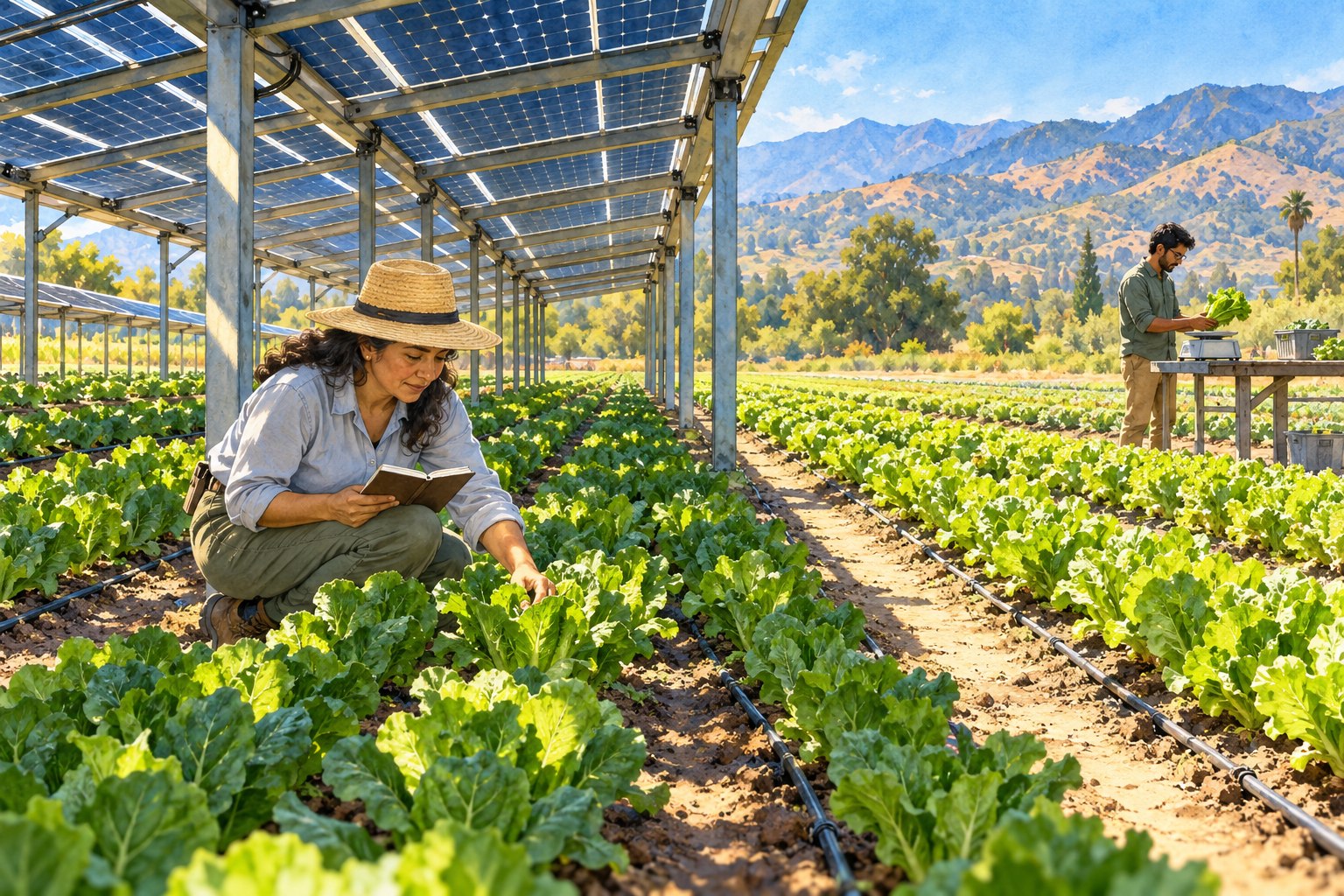
Picture a farm harvesting two useful things from the same patch of sunshine: fresh food below and clean electricity above. That is the appeal of agrivoltaics. It asks whether a solar installation can become part of a working farm, with the growing space designed as carefully as the power system.
At Cal Poly Pomona, a lettuce trial offers an encouraging example of that question being tested in the field. The opportunity is exciting because it connects everyday needs we usually discuss separately: food, water, land, and power.
What happened in the lettuce beds?
Cal Poly Pomona’s October 28 report describes preliminary results from its collaboration with Pitzer College’s Robert Redford Conservancy. Across five crop cycles beginning in summer 2025, students measured and weighed 3,556 romaine heads. In spring 2026, leaves beneath panels lost about half as much water as leaves in a nearby open field. Cooler-season yields in 2025 fell under the panels, while summer 2026 heads matched or exceeded open-field weights. Read the university’s results summary.
Those details belong together. A favorable summer harvest does not establish a year-round yield gain. And a leaf water-loss measurement does not establish a 50% reduction in irrigation. The public summary does not provide enough information to calculate farm-wide water savings, profitability, or electricity generated per pound of lettuce.
These are early findings presented at an October 20 conference, not a completed commercial performance guarantee. The report is a university account of the work; we have not reviewed a full trial dataset or peer-reviewed paper for these particular results.
Why a little shade could help
A plant needs light, but its growing environment involves more than maximizing sunlight. Heat, available moisture, and the timing of shade also matter. The Department of Energy’s farming guide explains that solar panels can change the microclimate below them, potentially easing heat stress and reducing water requirements for suitable crops. It also describes opportunities to diversify farm income. These are potential benefits, not a promise for every field. Explore the farmer’s guide.
Colorado State University Extension emphasizes the variables: climate, crop type, soil, panel height, and spacing can all change the outcome. Some crops have performed better under panels, others worse. That makes the design challenge more interesting than simply putting a roof over a field. Read the extension overview.
A California trial with questions for many places
The Spadra Farm project brings together the Huntley College of Agriculture and Pitzer’s conservancy. The university’s January project introduction describes the partnership and its research purpose. This is Cal Poly Pomona, not Cal Poly San Luis Obispo. See how the project began.
For Central Coast readers, it is a reason to pay attention to local experiments rather than assume a Pomona result transfers directly to a foggy coastal field or an inland vineyard. A useful next trial would match the crop, weather, and working practices of the people who might actually use it.
What would make this a good farm investment?
Here is our practical checklist for evaluating a proposal. Ask for the complete installed price, expected maintenance, and the cost of any changes to irrigation or harvesting. Check whether workers and equipment can move comfortably through the rows. Ask who owns the panels, who receives the electricity revenue or bill credit, and who pays to remove the equipment at the end.
Then ask for comparisons that cover more than the best harvest. How do marketable crop yields vary across seasons? How much irrigation water is actually applied? What electricity reaches the meter? Those questions can help distinguish a photogenic installation from a system that serves a farm well.
The reward could be meaningful: keeping food production central while making space for clean power. We do not need every farm to look the same for a good idea to spread. We need well-measured examples that help growers decide where it fits.
Evidence you can follow
Published and sources checked October 30, 2026. Research findings, prices, and recognition are attributed to the records below. Practical checklists and suggested next steps are Good Green’s editorial guidance. We have not tested the equipment or independently reproduced the research.