
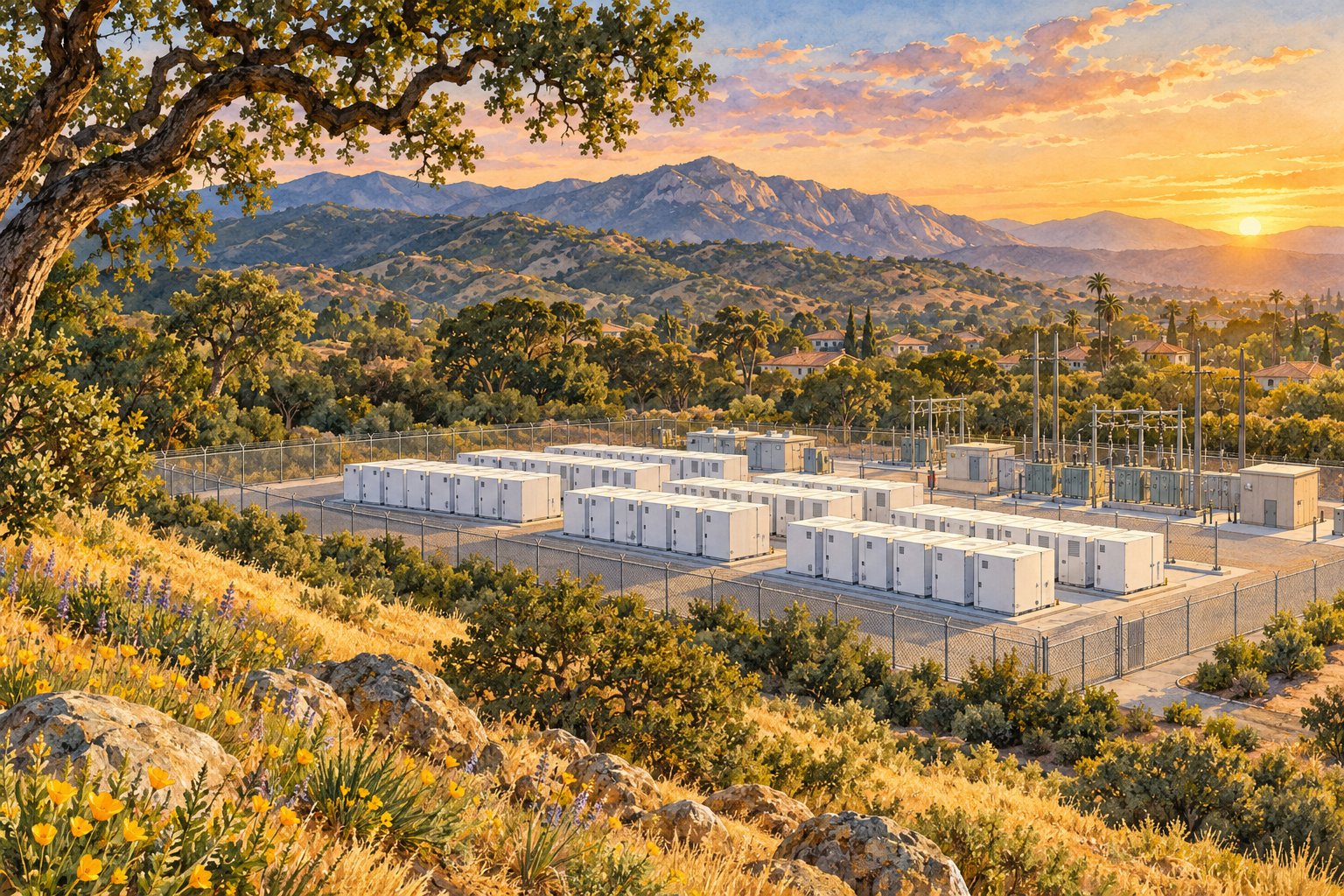
Picture the evening routine: dinner is cooking, lights are coming on, and someone plugs in the car. The sun has done its work for the day, but our need for electricity carries on. Storing energy gives communities another way to connect those two parts of the day. Pasadena’s next battery project is a hopeful example of that idea moving from a plan toward construction.
A community battery, with a specific job
Pasadena held an October 7 kickoff for its upcoming Glenarm Battery Energy Storage System. The city describes a 25-megawatt, four-hour lithium iron phosphate system intended to store carbon-free electricity and deliver it during evening peak demand. Completion is expected by mid-2027. It will be Pasadena’s first utility-scale battery system. Source: City of Pasadena announcement, October 8, 2026.
The environmental documents specify 100 megawatt-hours of storage within the existing Glenarm Power Plant site. It is shared utility infrastructure, rather than a battery that each household must buy. Source: project response-to-comments document, March 2025.
Power and energy: two different jobs
Give daytime energy an evening shift
A battery does not generate electricity. It changes when electricity is available. The Department of Energy explains that storage can absorb energy when supply is abundant and discharge it when demand rises. Some energy is lost along the way, so the source used to charge it matters. Source: solar energy and storage basics.
That makes a useful question for any clean energy project: what will it charge with, and what will its output replace? For Glenarm, the city’s stated goal is carbon-free charging and evening support. Actual operating records will tell us how well it delivers. We are not assigning the project a measured emissions reduction before it is running.
How stored sunshine can help
- Daytime: clean generation supplies electricity to the grid.
- Charging: a battery holds some energy for later, with conversion losses.
- Evening: stored energy returns to the grid when it is useful.
What does it cost, and could it lower bills?
The June 17, 2024 council agenda proposed a 15-year storage contract with a total ceiling of $55.31 million, including a $500,000 contingency. Its base service rate was $12.18 per kilowatt per month. Those are historical contract proposal figures, not a current construction invoice. The October 2026 announcement reports up to $9.66 million in state DEBA funding, a separate figure that should not be described as the total project cost. Source: council agenda, item 12.
For ratepayers, the important measure is the full cost of reliable service. Ask for updated contract terms, charging costs, operating expenses, and any projected effect on rates. A grant and a large battery do not establish household savings on their own. Good Green has not verified a promised monthly bill reduction from this project.
Build confidence as well as capacity
The March 2025 environmental review responses discuss NFPA 855 installation guidance, fire and gas detection, and emergency coordination. They also identify thermal runaway, fire, and toxic gas risks that need management. The proposed mitigation includes an emergency response and action plan, inspections, and prevention and detection equipment. These provisions are a reason to examine the design carefully, not evidence that the finished system has already passed commissioning. Read the safety discussion and responses, pages 14–16.
We have not independently verified an as-built certification record or final test report. Before operation, useful public updates would include the approved safety plan, applicable certification and test documentation, and a clear route for neighbors to raise concerns.
A good idea to bring to your own community
You do not need to buy a home battery to take part in cleaner energy. Ask your utility what it is doing to match renewable supply with evening use. Request public cost and performance information. If your household can shift a flexible load safely, check your rate plan before assuming a financial benefit.
For individual storage choices, our home battery guide explains how capacity, installation, and costs fit together. Community projects and household decisions can support the same goal: make clean electricity useful throughout more of the day.
Evidence you can follow
Checked October 10, 2026. This is a sourced project explainer, not a site inspection. The latest city announcement supplies the expected completion date; older documents describe earlier plans and contract proposals. We will revisit the story when operating data is available.