
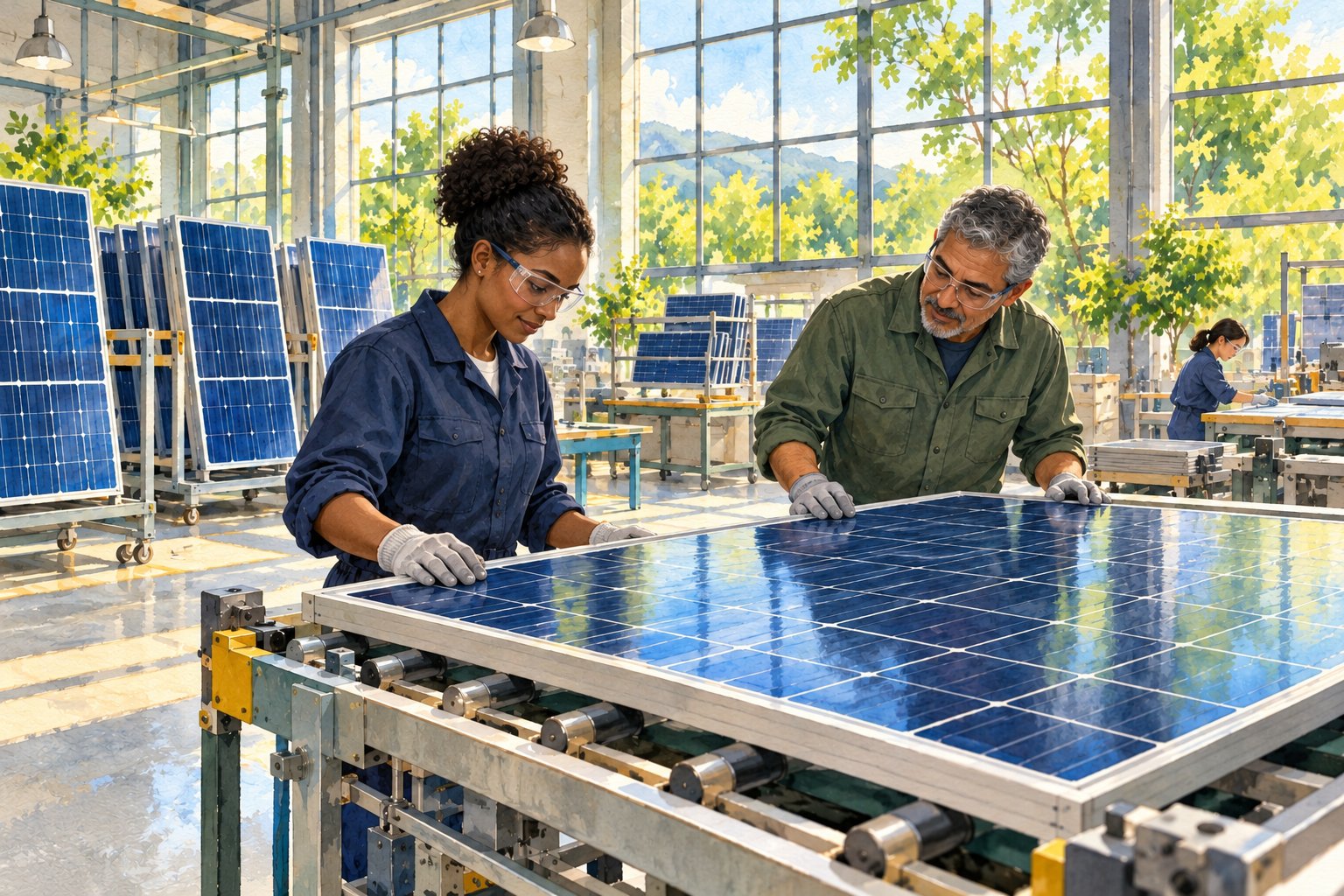
There is something satisfying about seeing a useful idea become an object: a solar panel ready for a roof, or a battery ready to store electricity for later. Behind those products are people, materials, machines, and a long chain of decisions.
A new assessment offers encouraging news about that chain in the United States. It also gives us a chance to ask a more useful question than whether a factory announcement sounds impressive: what is actually getting made and put to work?
The new snapshot
Rhodium Group’s October 15 Clean Investment Monitor report says US battery-cell, battery-module, and solar-cell manufacturing capacity roughly doubled between Q1 2025 and Q3 2026. It tracks 418 operating clean-energy manufacturing projects, up from 305. Those are different categories of equipment and projects, not one interchangeable production total. Read the supply-chain assessment.
The report also warns that reported capacity can exceed actual output. A factory may be operating without producing at its full stated rate. Announced projects and those under construction belong in separate categories from operating facilities. That distinction keeps a promising trend grounded.
A panel is the end of a longer journey
The Department of Energy describes the main crystalline-silicon manufacturing sequence: high-purity silicon becomes ingots, thin wafers, electricity-producing cells, and assembled modules. Modules are the panels we recognize. Other technologies, including thin-film solar, follow different manufacturing processes. Explore the manufacturing steps.
That helps explain why a domestic panel-assembly line does not, by itself, tell us where all its inputs were produced. Ask which manufacturing step a headline describes. A cell plant and a module plant solve different parts of the supply problem.
Reasons for optimism, questions to keep asking
A factory expansion is an opportunity to build useful skills and equipment. To understand its environmental value, we would also want evidence about material sourcing, energy use, waste handling, product durability, and what the equipment does once installed. A domestic address alone does not answer those questions.
Nor does a larger manufacturing base guarantee an immediately cheaper solar quote or battery. For a household project, ask for the equipment model, installation details, warranty responsibilities, and total delivered price. Compare that specific proposal with your needs rather than trying to translate a national capacity headline into personal savings.
Support the work that makes equipment useful
You can take an interest without buying anything today. At a local project meeting, ask about workforce training and ongoing maintenance. When evaluating a supplier, ask who handles repairs and replacement parts. A product that can be supported over time has a more useful story than an impressive launch announcement alone.
For a closer look at what deployment means in a community, read our Pasadena storage story. It follows a different part of the journey: planning how equipment will serve people after it leaves the factory.
Evidence you can follow
Published and sources checked October 19, 2026. This article draws on the dated sources below. Findings are attributed to their authors; the practical questions and next steps are Good Green’s editorial guidance.